How to Show Up in AI Search Results (It’s Simpler Than You Think)
As always, my job with these articles is to strip away the “complexity” surrounding today’s marketing practices and explain things in a way that anyone can understand.
Today, I am going to do just that with AI, and I’m going to explain why showing up in AI searches isn’t all that hard.
But before I jump into all that, let me rewind for a second.
Because AIO (AI Optimization), AEO (AI Engine Optimization), or whatever new fancy acronym people are coming up with nowadays, is not, in fact, all that different from what we once knew as SEO.
Let me explain:
For years, small business owners heard the same phrases over and over:
“Content is king.”
“You need good SEO.”
“Blog more if you want Google to notice you,” and so on.
The idea was that if you created good content and targeted the right search words (technically called “keywords”), your business would show up on the first page of Google when someone searched for the services or products you offered.
That was the game.
And for years, we all played it.
Well, that game hasn’t completely disappeared.
It has simply changed a bit.
While a lot of people are still using Google to find things, more and more people, and by that I mean several billion people daily, are now turning to AI for answers.
They’re opening ChatGPT and asking, “Whats wrong with my blah blah,” and “How do I fix it?”
They’re asking Perplexity to compare options and find better prices.
And they’re scrolling right past Google’s top search results because Google’s own AI Overview already gives them a complete answer before they had to click on anything.
So, naturally, the question becomes:
“How do I show up in AI search results?”
How can your business show up when someone searches for your products or services in AI searches?
How can you ensure that when someone asks AI for a solution you offer, your business is part of AI’s answer?
As I said at the start of this article, showing up in AI searches isn’t as complicated as it sounds and isn’t all that different from what most of us have been doing for years.
Yes, AI is new.
Yes, it’s advanced.
Yes, more and more people are turning to AI for answers.
Yes, it will one day either solve all our problems or destroy all humanity (joke!)
Yes, it feels like the ground shifted overnight and now we have to learn this whole new thing called AI search optimization.
But I’m here to tell you that showing up in AI searches doesn’t require you to learn some brand-new secret skill or a whole new approach.
It simply requires a few adjustments to things you were probably already doing, or should have been doing anyway.
So, with that, let’s now jump into this, starting with a very important question.
Table of contents
Does Content and SEO Even Matter Anymore?
Two Businesses, Same Service, Very Different Results
The Biggest Game-Changer in Showing up in AI Searches: Actually Answering Questions
Can Someone Figure Out What You Do in Three Seconds?
What You Can Do Yourself (Really, No Marketing Degree Required)
What's Worth Hiring Someone For
So, Is Showing Up in AI Search Complicated?
Frequently Asked Questions
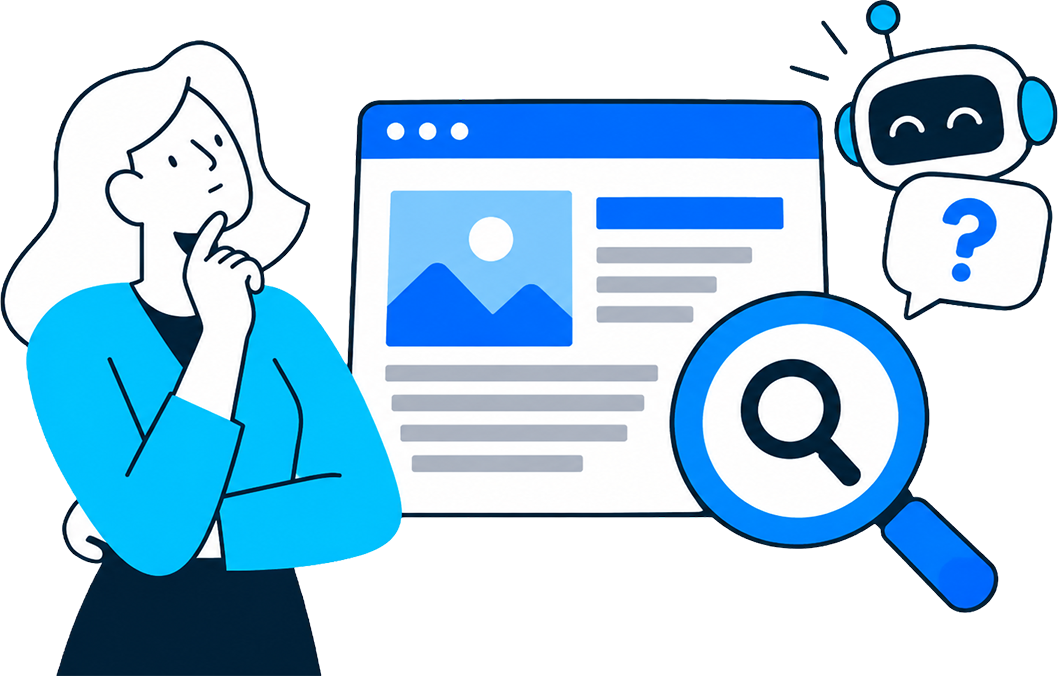
Content and SEO still matter a lot.
Why?
Because guess where AI goes to find its answers?
The internet, or as I like to call it “the interwebs.”
When your customer goes to ChatGPT or Claude or whatever platform, and asks it a question, AI goes to two places for the answer:
The first place it goes is its own database, one it has built by searching the internet and cultivated over time through its own learning process and by chatting with you and your customers.
And to verify its data, or if it can’t find a good answer or a current answer, it goes back to the internet for information.
Here’s word-for-word what Claude told me about where it gets its answers:
“I’m looking for a few things when I do that: pages that answer the question clearly and directly, sources that seem trustworthy and consistent with each other, and information that’s actually up to date. If five different sites all say the same accurate thing about a business, and one source contradicts it with outdated or incorrect info, I’m going to trust the consistent version over the outlier.
“So in plain terms: I go to the same internet everyone else searches, I just read a bunch of it fast and summarize the clearest, most consistent answer I can find.”
So if you’ve been putting time into your website, your content, your Google Business Profile, you weren’t wasting your time, and it’s not all gone down the drain.
You just need to make sure that content is built the way AI tools actually like to read it, which, as it turns out, isn’t all that different from how people like to read it either.
Your website content has to be:
Clear.
Consistent.
Organized.
Direct.
And most importantly, it needs to answer questions (more on this later).
So when it comes to content, not too much has changed.
The only difference is that a customer is no longer scrolling through Google looking for something or reading multiple articles to find the right answers; AI is doing all the reading, way faster, and producing a summarized answer to your customer’s question or request.
So, yes, content and SEO are still very relevant and important.
But the content on your website and the new content you produce have to follow slightly different rules now.
Now, let’s take a look at an example of how a business shows up in AI search results, versus one that doesn’t:

Let’s say there are two plumbing companies in the same town.
They offer the same exact services.
They have the same general pricing.
They both offer a free estimate.
They have experienced and licensed plumbers.
They have good reviews.
Let’s call the first company “Mike’s Plumbing.”
And the second one “Downtown Plumbing Co.”
Someone in town asks ChatGPT:
“Can you help me find a good plumber to help me with my water heater repair? It’s not producing hot water anymore.”
Here’s what AI sees when it goes looking for an answer.


Mike Plumbing.
Every time.
Not because Mike is a better plumber.
Not because Mike paid for some special AI search package.
Mike shows up because his information is clear, current, consistent, and actually answers the question someone asked.
AI isn’t guessing who’s more trustworthy; it’s just going with whoever made it easy to tell.
Downtown Plumbing Co. isn’t invisible because they did anything wrong.
They’re just invisible because they never gave AI a clear, consistent, organized, and direct answer to the search on water heaters.
And that, right there, is basically the whole game.
Now, you may have noticed something important here, and it actually ties back to one of the oldest and most important rules in business, let alone content, SEO, or AI search results:
You must answer people’s questions.

Most people don’t go to AI and type in a statement.
They go to AI and ask a question.
They’re not typing “plumber Miami” into ChatGPT the way they used to type it into Google.
They’re asking, “My water heater is making a weird noise, should I be worried?”
And you guessed it: whoever answers that question clearly, consistently, organized, and directly, wins.
One of the most effective things you can do to show up in AI search results is start answering real questions.
Not vague, marketing-brochure questions.
Real ones, the kind your customers actually ask.
And you probably already have this information; you just haven’t put it on your website yet.
Talk to your engineers.
Talk to your technicians.
Talk to your sales team.
Talk to customer service.
Talk to anyone who is fielding real questions from real customers, every single day.
Ask them what questions people are asking the most, what questions do they find themselves constantly answering, and what questions do customers ask during a sales call?
Write those questions down.
And then write clear, consistent, organized, and direct answers to each.
Once you have that list, turn it into content.
Blog posts that answer one specific question each.
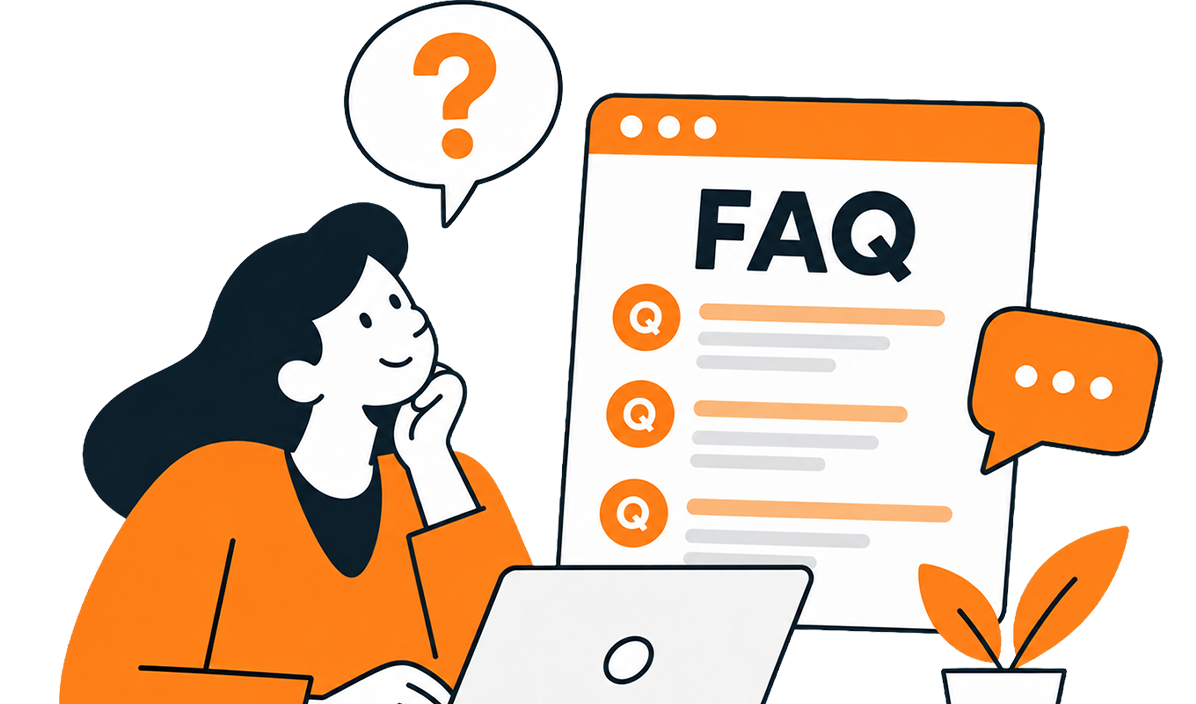
An FAQ section on your website with real questions and real answers, not fluff.
Even social media posts or a quick video shot on your phone, answering one common question at a time, works great.
Why does this work so well?
Because it’s exactly the format AI is looking for.
AI isn’t trying to interpret your marketing language and figure out what you meant. It’s looking for a direct answer to a direct question, so it can hand that answer to the person who asked it.
Here’s an example of two good answers; can you guess which one is most likely to appear in an AI search result?
Question:
How much does it cost to replace my water heater?

They’re the ones who took the time to answer the questions people are actually asking.

If I looked at your website or your social media page right now, having no idea who you are or what you do, could I figure it out in three seconds?
Just from one glance?
By reading a single sentence?
I ask this because, in addition to answering people’s questions, it’s one of the most important factors in content, SEO, and AI search result optimization.
Now, we’ve been using plumbers as the example throughout this article, and plumbing is easy.
The word “plumber” or “plumbing” kind of says it all.
But a lot of businesses aren’t that simple to explain, and that’s exactly where things fall apart.
Here’s the real test:
Take a piece of paper and write down what you do in a single sentence.
Now, the next time someone asks you what you do, read that to them.
Did it answer their question, or did they ask more questions to try and understand it better?
Let me give you an example.
I watched a video the other day of a commercial real estate broker in New York named Bob Knakal explaining what he does in three words.
He talks about how, when he first got into the business, many people around him had fancy, complicated titles.
Some tried to brand themselves as a “capital markets intermediary,” and other things. Technically accurate, sure, but if you don’t already work in that world, you have no idea what that actually means.
Bob didn’t do that. He just said, “I sell buildings.”
That’s it.
If I were in the market for a building, I’d immediately start asking about buying.
If I wasn’t, I’d just think ‘oh, cool’ and move on, but either way, I’d know exactly what he does.”
That’s the goal.

It should state what you do in one clear sentence, so clear that the next question out of someone’s mouth is a buying question, something like “how much?” or “what’s the process to get that done?”
Not “wait, so what do you actually do?”
You’d be amazed how many websites spend entire paragraphs explaining what they do, using big, fancy words, and by the end, the visitor either bounces or still has no idea what the business actually offers.
And here’s why this matters just as much for AI search visibility as it does for a real person landing on your site:
AI works exactly the same way.
It’s not on your side.
It’s not rooting for you.
It’s simply trying to help the person who asked it a question, as fast and as clearly as possible. AI doesn’t favor your business in any special way; it favors whichever business makes it easiest to answer the question.
So if a real human can’t figure out what you do in three seconds, neither can AI.
And if AI can’t figure it out, it’s not going to feature you in ChatGPT, in an AI Overview, or anywhere else someone’s asking a question you could’ve answered.
Alright, now let’s jump into some actionable steps.
I’ve broken this down into two parts: first, what you can do yourself, and second, what you should probably pay someone to do, whether that’s an in-house marketing person or a marketing company (like us!).

A lot of what improves your AI search visibility is stuff you can do yourself, today, without hiring anyone.
#01
Clean Up Your Google Business Profile
Make Sure Your Info Matches Everywhere

Answer the Actual Questions People Ask
Add an FAQ Section
Keep Things Updated
None of that requires a marketing background. It just requires a little time and consistency.

Backlinks
Keyword and Question Research
Structured Data and Technical Setup
Tracking Your Visibility
That’s the honest line I’d draw: the visibility fundamentals, you can absolutely handle yourself. The technical and strategic layer underneath it is where it makes sense to bring someone in.
Not really.
It’s a shift, sure.
But it’s not a mystery.
Keep your information accurate and consistent.
Answer real questions clearly.
Keep your content current.
Do those things, and you’re already ahead of a lot of businesses who haven’t adjusted at all yet.
And if you get to the point where you want the deeper, more technical side handled- backlinks, keyword strategy, tracking your visibility- that’s exactly the kind of thing my company helps small businesses with every day.
For now, start with the basics above.
You’ll be surprised how far that alone takes you.
What are AI search results?
How is AI search different from regular Google search?
How do I get my business to show up in ChatGPT?
Does SEO still matter now that people use AI for search?
What’s the difference between SEO, AEO, and AIO?
How long does it take to start showing up in AI search results?
Do I need to hire someone to show up in AI search, or can I do it myself?
What’s the single easiest thing I can do today to improve my AI search visibility?
Free Homepage Design
Get a stunning, custom homepage for free!
Limited-time offer—claim yours now!